FBA vs FBM in 2026: Costs, Break-Even and Which to Choose
FBA vs FBM on amazon.com in 2026: every cost that differs, two worked examples with real fees, the break-even shipping cost and which products suit each method.
With FBA, Amazon stores your stock, packs and ships each order, and handles returns and delivery questions. Your listings get the Prime badge, and you pay a fulfillment fee per unit, monthly storage and, depending on how you send stock in, an inbound placement fee. With FBM (fulfilled by merchant), you ship every order yourself and pay your own postage, packaging and labor. The referral fee and the selling plan are the same either way. FBA usually comes out ahead for small, light items that sell fast. FBM usually wins for heavy, bulky, slow-selling, low-margin or made-to-order items.
This guide covers sellers on amazon.com in the US, with fees taken from Amazon’s own Seller Central and Sell on Amazon pages and checked on 27 October 2026. Below: what each option does, the costs that differ, two worked comparisons with real 2026 rates, which products suit each method, and how to check your own product.
FBA vs FBM at a glance
| FBA (Fulfillment by Amazon) | FBM (fulfilled by merchant) | |
|---|---|---|
| Who stores the stock | Amazon fulfillment centers | You, or a warehouse you pay |
| Who packs and ships | Amazon | You |
| Returns and delivery questions | Amazon | You |
| Prime badge | Yes | Only through Seller Fulfilled Prime |
| Amazon fees | Referral fee, plan, fulfillment fee, storage, inbound placement and a few situational fees | Referral fee and plan only |
| Your own costs | Product, prep, shipping stock to Amazon | Product, postage, packaging, labor, storage space |
| Control | Less: Amazon sets packaging and delivery | Full: your packaging, carrier and inserts |
If you are new to the program itself, What Is Amazon FBA explains how it works from the first shipment.
The costs that are the same either way
Two Amazon charges do not change with the fulfillment method:
- Selling plan. Professional costs $39.99 a month; Individual costs $0.99 per item sold.
- Referral fee. In most categories it is 15% of the total price, with a $0.30 minimum per item. Some categories differ: Computers pay 8%, and Clothing pays 5% up to $15, 10% from $15 to $20 and 17% above $20. Media items add a $1.80 closing fee.
One detail matters for FBM. Amazon charges the referral fee on the item’s total price, which includes the shipping the buyer pays and any gift wrap. If you sell a $25 item and charge $5 shipping, the 15% fee is $4.50 on $30, not $3.75 on $25. Source: Amazon selling plans and pricing. Check the exact rate for your category with the referral fee calculator.
What FBA costs in 2026
FBA adds Amazon’s own fees on top of the referral fee and plan. These are the ones that usually decide the comparison.
Fulfillment fee
A fee per unit shipped, set by size tier, shipping weight and price. Small standard items use the unit weight; large standard and bulky items use the greater of the unit weight and the dimensional weight. Since 17 April 2026, Amazon has added a 3.5% fuel and logistics surcharge to FBA fulfillment fees, and the rate tables do not include it. A few rows for non-apparel items priced $10 to $50, valid 15 January to 14 October 2026:
| Size tier and shipping weight | Fee per unit | With 3.5% surcharge |
|---|---|---|
| Small standard, 6+ to 8 oz | $3.54 | $3.66 |
| Large standard, 1+ to 1.25 lb | $5.04 | $5.22 |
| Large standard, 2.75+ to 3 lb | $6.67 | $6.90 |
| Small bulky, 0 to 50 lb | $7.55 + $0.38 per lb above the first | from $7.81 |
Items under $10 get Low-Price FBA rates, which Amazon says are $0.86 lower on average.
From 15 October 2026 to 14 January 2027, holiday peak fees apply, and the surcharge applies to them too. For example, the large standard 1+ to 1.25 lb tier at $10 to $50 is $5.34 in the peak table, or $5.53 with the surcharge. Source: FBA fulfillment fees. The full tables are in Amazon FBA fees 2026 and 2026 peak fulfillment fees.
Monthly storage
Amazon charges storage per cubic foot of average daily volume. For non-dangerous goods, standard-size items cost $0.78 per cubic foot from January to September and $2.40 from October to December. Oversize items cost $0.56 and $1.40.
A storage utilization surcharge applies only to Professional sellers whose first shipment was more than 365 days ago, who store at least 25 cubic feet on average in that size tier and whose stock covers more than 22 weeks of sales. New sellers, Individual sellers and accounts below that volume pay the base rate only. Source: Monthly inventory storage fees.
Inbound placement
When you send stock in, you choose how it is split between warehouses. With Amazon-optimized splits there is no placement fee, but you need at least five identical cartons or pallets per item. With minimal splits you pay per unit: for example, $0.24 to $0.50 for a large standard item from 12 oz to 1.5 lb. Amazon charges the fee 45 days after it receives the stock. Source: FBA inbound placement service fee.
Aged inventory surcharge
Units stored 181 days or more pay a surcharge on top of monthly storage. It starts at $0.50 per cubic foot for 181 to 210 days and rises to $5.45 at 271 to 300 days and $7.90 per cubic foot (or $0.35 per unit, whichever is greater) from 456 days. The three tiers from 181 to 270 days do not apply to clothing, shoes, bags, jewelry and watches. Together with monthly storage, this is what makes slow sellers expensive in FBA. Source: Aged inventory surcharge.
Fees that apply only in some cases
- Low-inventory-level fee: charged on units shipped when a standard or bulky product falls below 28 days of supply.
- Returns processing fee: charged in some cases when Amazon gives the buyer free return shipping.
- Removal and disposal fees: per item, when you ask Amazon to send back or dispose of stock.
Your own FBA costs and new-seller credits
Two costs are yours, not Amazon’s: prepping and labeling units, and freight to the fulfillment center.
New sellers and new products can offset some FBA costs with credits. FBA New Selection offers free monthly storage and referral fee discounts on eligible new products, and new Professional sellers get a $400 inbound placement credit and $100 off Partnered Carrier inbound shipping. The examples below do not count these credits. Source: Fulfillment by Amazon.
What FBM costs
With FBM, Amazon charges only the referral fee and plan. Everything else is a cost you set, and no official table lists it:
- Postage: the label to the buyer, which depends on your carrier, rates, package size and distance.
- Packaging: boxes, mailers, tape, fill.
- Labor: the time to pick, pack and print, yours or someone you pay.
- Storage: your shelf space, garage or a third-party warehouse.
- Returns and customer service: you handle the messages, return labels and restocking.
Estimate each one per unit from your own invoices and labels. In the examples below, every FBM figure is an assumption, labeled as one. Replace them with your own.
Two worked comparisons: when FBA wins and when FBM wins
Both examples use a 15% referral category and the 2026 rates above. They assume the same price and the same sales either way, and leave out the plan fee and ads, which apply to both, and returns, which depend on your product and are handled differently by each method. Each table shows the January to September rates and the peak result for a unit sold between 15 October and 31 December, when peak fulfillment fees and October to December storage rates overlap.
Example A: a $25 item that weighs just over a pound (FBA wins)
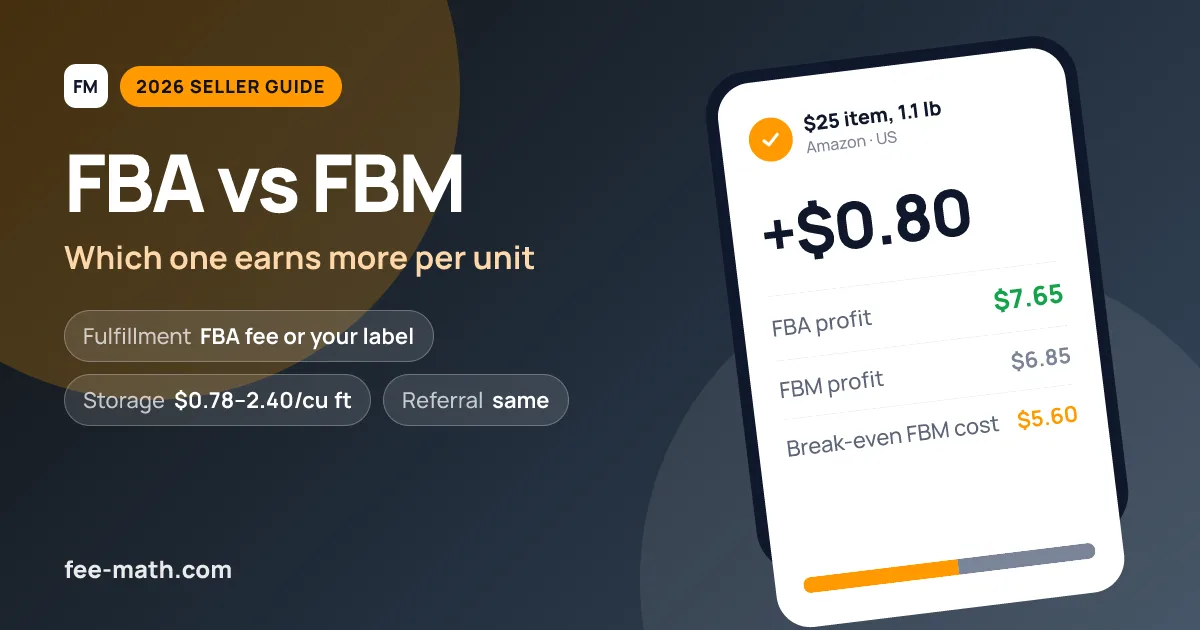
A $25 item, 1.1 lb, in a 0.1 cubic foot box, with an $8 landed product cost. We assume the box is small enough that its shipping weight stays in the large standard 1+ to 1.25 lb tier. It sells within a month. Stock goes in with Amazon-optimized splits, so there is no placement fee.
| Per unit | FBA, Jan–Sep | FBA, peak | FBM |
|---|---|---|---|
| Price | $25.00 | $25.00 | $25.00 |
| Referral fee (15%) | −$3.75 | −$3.75 | −$3.75 |
| FBA fulfillment fee + 3.5% surcharge | −$5.22 | −$5.53 | — |
| Storage, one month (0.1 cu ft × $0.78 or $2.40) | −$0.08 | −$0.24 | — |
| Shipping to Amazon (assume $0.30) | −$0.30 | −$0.30 | — |
| Label to the buyer (assume $5.50) | — | — | −$5.50 |
| Packaging (assume $0.40) | — | — | −$0.40 |
| Packing labor (assume $0.50) | — | — | −$0.50 |
| Product cost, landed | −$8.00 | −$8.00 | −$8.00 |
| Profit per unit | $7.65 (30.6%) | $7.18 (28.7%) | $6.85 (27.4%) |
FBA earns $0.80 more per unit from January to September and $0.33 more during peak, if your FBM costs stay at $6.40. Before inbound shipping and storage, the FBA side is $8.03 (32.1%), the same result as the worked example in What Is Amazon FBA.
The break-even is the sum of the costs only FBA has, per unit: the fulfillment fee with the surcharge, storage, shipping to Amazon and any placement fee. Here that is $5.22 + $0.08 + $0.30 = $5.60 per unit, or $6.07 during peak. FBM wins only if your label, packaging and labor together cost less than that (both examples assume no separate prep cost, and no separate FBM storage cost for an item this small). Three things change the picture:
- Minimal splits add $0.24 to $0.50 per unit, cutting FBA’s January to September lead to $0.30 to $0.56.
- Carrier rates may also rise around the holidays, so price your FBM labels for the same weeks.
- Charging the buyer for shipping raises your FBM referral fee, because the fee applies to the shipping too.
Example B: a heavy item that sells slowly (FBM wins)
A 25 lb item priced $45, in a 16 × 12 × 8 inch box (0.889 cubic feet), with a $15 landed product cost. Large standard-size stops at 20 lb, while small bulky covers items up to 50 lb and 37 × 28 × 20 inches, so this item is small bulky (product size tiers). We assume its dimensional weight is below the 25 lb unit weight, so the fee uses 25 lb.
Outside peak, the fulfillment fee is $7.55 plus $0.38 for each of the 24 pounds above the first ($9.12): $16.67, or $17.25 with the surcharge. During peak it is $8.59 plus the same $9.12: $17.71, or $18.33 with the surcharge.
Amazon’s storage table lists only standard-size and oversize rates, and a bulky item is not standard-size, so the example uses the oversize rate. It sells slowly: a unit sits about four months before it sells. The peak column assumes a unit that arrived in September and sold in December: one month at $0.56 and three at $1.40.
| Per unit | FBA, Jan–Sep | FBA, peak | FBM |
|---|---|---|---|
| Price | $45.00 | $45.00 | $45.00 |
| Referral fee (15%) | −$6.75 | −$6.75 | −$6.75 |
| FBA fulfillment fee + 3.5% surcharge | −$17.25 | −$18.33 | — |
| Storage, four months (0.889 cu ft) | −$1.99 | −$4.23 | — |
| Shipping to Amazon (assume $1.50) | −$1.50 | −$1.50 | — |
| Label to the buyer (assume $14.00; use your own rate) | — | — | −$14.00 |
| Packaging (assume $0.80) | — | — | −$0.80 |
| Packing labor (assume $0.70) | — | — | −$0.70 |
| Your own storage space (assume $0.25) | — | — | −$0.25 |
| Product cost, landed | −$15.00 | −$15.00 | −$15.00 |
| Profit per unit | $2.51 (5.6%) | −$0.81 (−1.8%) | $7.50 (16.7%) |
FBM earns $4.99 more per unit from January to September, and FBA loses money on a unit that sells in December. FBA would only catch up if your total FBM cost (label, packaging, labor and storage) rose above $20.74 per unit, or $24.06 during peak. That break-even is again the sum of the FBA-only costs: $17.25 + $1.99 + $1.50, or $18.33 + $4.23 + $1.50 during peak.
Time works against FBA here. If a unit sits past 180 days, the aged inventory surcharge is added on top of storage.
Run your own product
The break-even is the useful number: the FBM cost per unit at which both methods earn the same. Enter your price, fees and FBM costs below to find it for your product. Put your total FBM cost per unit (label, packaging, labor and your own storage) in the field “Your shipping to the buyer (FBM)”; the result “FBM shipping cost at which both tie” is then the break-even described above. If you use minimal splits, add the placement fee to “Shipping to Amazon per unit (FBA)”.
FBA vs FBM CalculatorAmazon warehouse or your own shipping: which wins.Open calculator →The comparison does not count the sales Prime can win you. FBM listings without Prime may have to sell for less or may convert fewer visitors, so if FBM wins only narrowly, FBA can still be the better choice. The calculator lets you enter a lower FBM price to test that.
Which products suit FBA and which suit FBM
This table is our reading of how the fees are built and of the two examples above, not an Amazon rule. Check any product against your own numbers.
| Product | Usually better with | Why |
|---|---|---|
| Small, light, fast-selling | FBA | Low fulfillment fee, little storage, Prime badge |
| Mid-price standard items with steady sales | FBA, but check | In Example A the gap was $0.80 per unit, so your own shipping costs decide it |
| Heavy items (over 20 lb) and bulky items | FBM | Bulky fees add $0.38 per lb and can exceed what you pay to ship yourself |
| Slow sellers and long-tail items | FBM | Storage and the aged inventory surcharge build up month after month |
| Low-margin items | FBM, or test both | A fee change of under a dollar can wipe out the profit |
| Made-to-order, personalized, fragile | FBM | You cannot pre-stock them, or you need your own packing |
| Seasonal stock for Q4 | Check both | Peak fulfillment fees apply from 15 October to 14 January, and storage rises to $2.40 (standard-size) or $1.40 (oversize) per cubic foot from 1 October to 31 December. If you use FBA, send only what you expect to sell by December and price it with the peak figures |
Seller Fulfilled Prime: the Prime badge without FBA
Seller Fulfilled Prime puts the Prime badge on listings you ship yourself. To join, you need a Professional account and a default ship-from address in the US. You first complete a 30-day trial in which you meet Amazon’s performance requirements, and you ship Prime orders with one-day and two-day shipping templates. Amazon handles post-order customer service for Prime items, and using Buy Shipping gives you account-health protections.
It suits sellers who already ship fast and want Prime without paying FBA fees, and it fits heavy items that are expensive in FBA. The cost is a fast-delivery promise you must keep on every order. Source: Seller Fulfilled Prime.
Using both methods
You do not have to pick one method for the whole catalog. You can choose the method per product:
- FBA for the best-sellers, where storage per unit stays low and the Prime badge counts most.
- FBM for the long tail, heavy items and anything that would sit in storage for months.
Review a product’s fulfillment method when its numbers change, for example when sales slow and its FBA storage costs keep growing. For products you keep in FBA, stay above 28 days of supply, because falling below it triggers the low-inventory-level fee.
How to decide for one product
- Find the size tier and fee. Measure and weigh the packaged item, find its size tier and shipping weight, and look up the fulfillment fee, then add 3.5%.
- Estimate storage time. How long will a unit sit before it sells? Multiply the volume by the rate for each month, and check whether any units would pass 180 days.
- Add your FBA costs. Prep, freight to Amazon, and the placement fee if you use minimal splits.
- Price your FBM costs from real labels. Postage, packaging, labor and storage space per unit, plus what returns cost you.
- Compare against the break-even. Add up steps 1 to 3 per unit: that sum is your break-even. If your FBM cost from step 4 is well below it, ship it yourself. If it is close, consider what Prime is worth for that product.
- Check again for peak. Storage rises from 1 October and fulfillment fees from 15 October, and carrier rates may rise too.
Calculate your own numbers
Use the FBA vs FBM calculator to compare profit per unit and per month for your product and see the break-even in both directions. For a full FBA profit breakdown with ROI and break-even price, use the FBA profit calculator. The full fee tables are in Amazon FBA fees 2026.
Try it in the calculator
Questions and answers
What is the difference between FBA and FBM?
With FBA, Amazon stores your stock, ships each order and handles returns, and your listings get the Prime badge; you pay a fulfillment fee, monthly storage and possibly an inbound placement fee. With FBM, you store and ship orders yourself and pay your own postage, packaging and labor. The referral fee and selling plan are the same either way.
Is FBA or FBM cheaper?
It depends on the product. For a $25 item weighing just over a pound, FBA earned $7.65 per unit against $6.85 with FBM in our January–September example. For a 25 lb item that sits for months, FBM earned $7.50 while FBA earned $2.51, and lost money on a December sale.
How do I find the break-even between FBA and FBM?
Add up the costs you pay only with FBA for one unit: the fulfillment fee, storage for the months it sits, and your shipping and placement cost to Amazon. If your total FBM cost per unit (label, packaging, labor and storage) is below that sum, FBM earns more; if it is above, FBA does.
Can I get the Prime badge without FBA?
Yes, through Seller Fulfilled Prime. You need a Professional account and a US ship-from address, and you must pass a 30-day trial meeting Amazon’s performance requirements with one- and two-day shipping options.
Do FBA fees go up in the holiday season?
Yes. Monthly storage for standard-size items rises from $0.78 to $2.40 per cubic foot from 1 October to 31 December, and peak fulfillment fees apply from 15 October 2026 to 14 January 2027, with the 3.5% fuel and logistics surcharge on top.